Almonds from Berkane: Harvest, Benefits, and Terroir Flavours
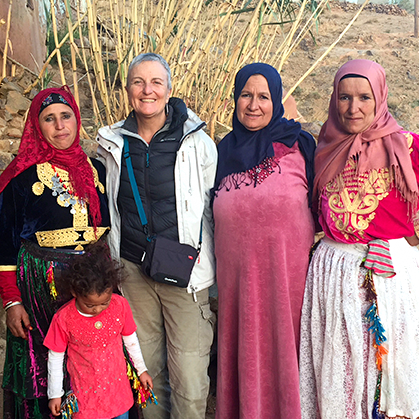
They are sweet, fleshy, full of sunshine. The almonds we offer have just been harvested in Berkane, in eastern Morocco, a region where almond trees have been cultivated for centuries. Here, the harvest is not an individual affair: it mobilises the entire community, from men to women, from children to elders. And once the fruit has been gathered, another skill comes into play — that of Berber women who shell the almonds with a stone, with a dexterity that only years of practice can achieve. A fruit of the terroir, rich in flavour and nutrients, suited to a thousand uses.
Berkane: A Land of Almond Trees for Centuries
Almond trees have been cultivated in Morocco since Carthaginian times, in the 4th century BCE. Their cultivation then developed under Arab influence, particularly in the piedmont regions where the climate suits them. Today, Morocco has around 190,000 hectares of almond trees, mainly in the Fès-Meknès, Beni Mellal-Khénifra, and Oriental regions.
The region of Berkane, in the Oriental, holds a special place. It enjoys a Mediterranean climate, with mild winters and hot summers, as well as well-drained soils perfectly suited to almond trees. The commune of Raslan has become the country's leading almond producer, and the region is renowned for the quality of its fruit.
Farmers in Berkane perpetuate ancestral practices. In the piedmont areas, century-old almond trees still stand, some planted over a hundred years ago. These trees, adapted to local conditions, produce almonds of remarkable quality.
Our almonds come from Najib, a farmer in Berkane, as well as from a specialised cooperative in the region. A collaboration founded on trust and a shared requirement: raw products, grown with respect for the environment, and harvested using traditional methods.
The Harvest: A Moment of Community Sharing
At harvest time, the villages of the Berkane region come alive. It is not a solitary activity: the entire community takes part. Men, but also women, children, and elders. Everyone has a role, and the work is done in an atmosphere of sharing and conviviality.
The Gaulage Technique
The traditional harvesting method is gaulage. Armed with long poles, workers strike the branches of the almond trees to bring down the ripe fruit. The gesture must be precise: the aim is to detach the almonds without damaging the branches, which will bear the following year's fruit.
Once the almonds have fallen to the ground, they are picked up one by one, often on bended knee or crouched, taking care not to leave any fruit behind. It is physical work, requiring endurance, especially under the region's sun.
H3 – Transmitted Know-How
Gaulage and gathering are simple gestures in appearance, but they require experience. The elders know how to recognise the optimal moment to harvest: neither too early, when the almonds are still tender, nor too late, when the shells begin to open. This know-how is passed down from generation to generation, within families and communities.
H2 – Shelling: The Know-How of Berber Women
Once the almonds have been gathered and dried, comes the shelling stage. This work is traditionally entrusted to women, who carry it out using a stone.
H3 – A Stone for Life
Each Berber woman had, from a very young age, her own stone. This simple tool, chosen for its shape and hardness, accompanied her throughout her life. The stone was not merely an instrument: it was part of her daily life, her identity, her work.
H3 – The Art of Not Breaking the Almond
The gesture is one of extreme precision. It is not about breaking the shell any which way, but about opening it without damaging the almond inside. One blow too hard, and the precious almond is broken, losing its value. It takes years of practice to master this gesture, to find the right force, the exact angle, the steady rhythm.
H3 – Impressive Dexterity
Watching these women work is a spectacle. The speed of execution, the regularity of the gesture, the precision of the stone's strike — everything bears witness to a know-how transmitted and perfected over generations. Their fingers move with an assurance that leaves no room for hesitation. They are true experts, and their work commands respect.
H3 – A Living Heritage
This gesture, inherited from Amazigh traditions, is still practised today in the villages of the Berkane region. It represents an essential part of the family economy and a direct link to the region's history. Every almond shelled by hand carries the trace of this know-how.
H2 – The Benefits of Almonds: A Concentrate of Health
Almonds are not only flavourful. They are one of the most nutritionally rich dried fruits.
H3 – Rich in Good Fats
Almonds are composed of around 50% lipids, mainly monounsaturated fatty acids (such as oleic acid) and polyunsaturated ones. These "good fats" help reduce bad cholesterol (LDL) and increase good cholesterol (HDL), promoting good cardiovascular health.
H3 – An Exceptional Source of Calcium
With around 269 mg of calcium per 100 g, almonds are among the best plant sources of this mineral. Calcium is essential for bone and dental health, muscle contraction, and nerve transmission. For those who do not consume dairy products, almonds are a valuable ally.
H3 – Rich in Magnesium and Vitamin E
Almonds also provide magnesium (around 270 mg per 100 g), an anti-fatigue mineral involved in more than 300 enzymatic reactions in the body. They are also rich in vitamin E, a powerful antioxidant that protects cells against oxidative stress.
H3 – A Boost for Satiety
Thanks to their fibre and protein content, almonds slow digestion and provide a lasting feeling of satiety. A handful of almonds between meals helps manage hunger, without resorting to industrial snacks.
H3 – A Healthy Snack, Without Guilt
A handful of almonds (around 30 g) provides lasting energy, essential nutrients, and genuine taste pleasure. Unlike biscuits or chocolate bars, it does not cause a glycaemic spike followed by a crash. It is a healthy snack that supports physical and mental effort.
To enjoy them fully, leave them to soak overnight in a bowl of cold water. The next day, they will be softer, more digestible, and can be enjoyed fresh and juicy, almost milky. A simple gesture that completely transforms the experience.
H2 – A Thousand and One Almond Recipes
H3 – Moroccan Pastry
-
Ghoriba with almonds: these small Moroccan macaroons, made with almond powder, sugar, and butter, are a pastry classic.
-
M'hancha with almonds: a spiral-shaped pastry, filled with almond paste and orange blossom, and coated in honey.
-
Gazelle horns: Morocco's emblematic pastry, with its almond filling flavoured with cinnamon and orange blossom.
-
Almond briouates: crispy triangles, filled with almonds and flavoured with orange blossom.
H3 – Everyday Uses
-
Amlou: this paste made from almonds and argan oil is a staple of the Moroccan breakfast. To be enjoyed on bread or pancakes.
-
Almond milk: blend soaked almonds with water, strain, and enjoy a homemade plant-based drink, without additives.
-
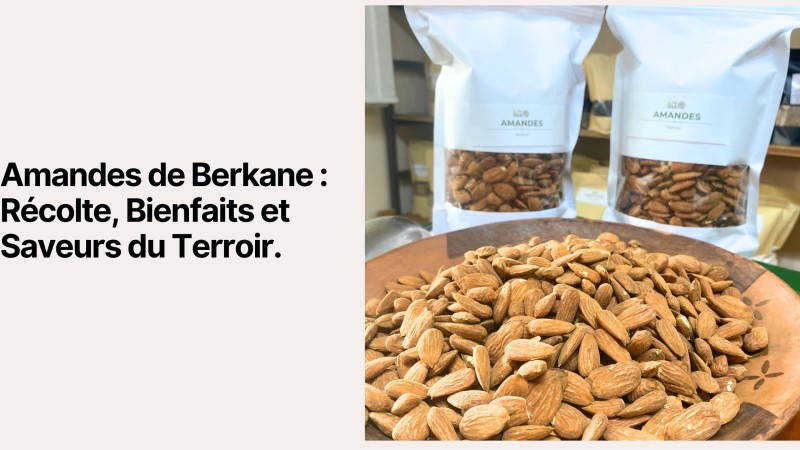
Roasted almonds: to be enjoyed plain, as an appetiser, or in salads.
H2 – The Green Souk: Almonds from Berkane, from a Short Supply Chain
At The Green Souk, our commitment is to offer you products that make sense. Our almonds come from Najib, a farmer in Berkane, and from a specialised cooperative in the region.
-
Origin: almonds grown in Berkane, in eastern Morocco.
-
Traditional harvest: manual gaulage, hand-gathering, respect for natural cycles.
-
Manual shelling: shelling carried out by Berber women, using ancestral know-how.
-
Guaranteed freshness: our almonds come from this year's harvest.
-
Traceability and fair pay: direct work with producers, without intermediaries.
We invite you to discover our almonds in our selection of dried fruits and to follow our news on Instagram, Facebook, and our WhatsApp group so you don't miss any of our arrivals.
Conclusion
Almonds from Berkane are not a simple dried fruit. They embody ancestral know-how — that of the men who strike the trees, that of the women who shell with remarkable precision — and a concentrate of nutrients beneficial to health. Rich in good fats, calcium, magnesium, and vitamin E, they are a healthy and indulgent snack.
By choosing those from The Green Souk, you are supporting local producers and respectful agriculture. You are choosing authentic taste and quality.
Discover our almonds from Berkane in our selection of dried fruits.