

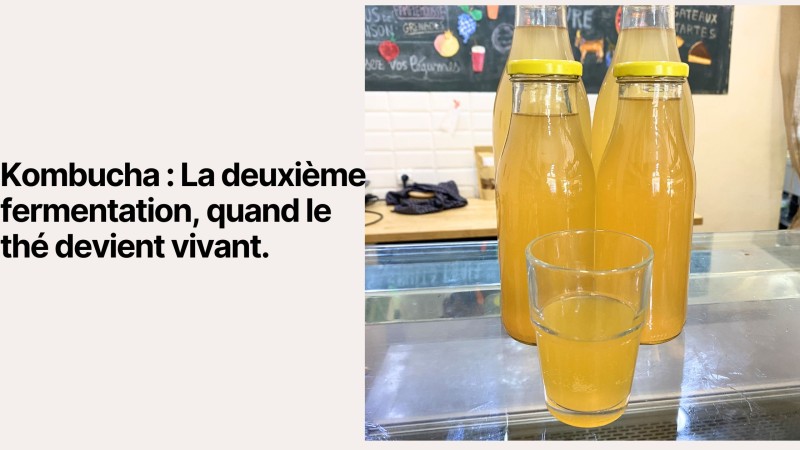
Kombucha: The Second Fermentation, When Tea Comes Alive
Kombucha is not a drink like any other. Behind its light effervescence and tangy taste lies a millennia-old fermentation process. At The Green Souk, we produce an unpasteurised kombucha, made from organic tea and fruit. Every week, a new flavour is created. But before it reaches your glass, this drink goes through two distinct fermentations, the second of which — the one that gives it its fizz and aromas — deserves closer attention.
An Ancient History, a Rapid Spread
The exact origin of kombucha remains shrouded in mystery. Its birthplace is thought to be in East Asia, probably in China or Japan, over 2,000 years ago. From there, the drink spread to Russia, then Europe, and finally the United States. Its popularity has never stopped growing, driven by a reputation for health benefits and a unique taste.
This rapid spread has a simple explanation: kombucha is good, and it does you good. Once you have tasted this sparkling, refreshing drink, it is hard to go without it. And when you discover its effects on digestion and energy, you understand why it has conquered so many cultures.
The First Fermentation: The Birth of Kombucha
It all starts with a simple base: sweet tea. An infusion of tea (black or green) is prepared, sugar is dissolved in it, it is left to cool, and then the SCOBY is added. The container is covered with a clean cloth, never sealed airtight, because air is essential for the activity of the micro-organisms.
H3 – The Role of the SCOBY
SCOBY stands for Symbiotic Culture of Bacteria and Yeast. This gelatinous disc harbours dozens of microbial species living in symbiosis. The yeasts consume the sugar and produce ethanol and carbon dioxide. The acetic bacteria then transform this ethanol into acetic acid, which gives kombucha its characteristic tangy flavour.
This biofilm is not a "mushroom" in the strict sense — the term is misleading. It is a living matrix, an ecosystem in its own right, which protects the drink from external contamination while allowing the gaseous exchanges necessary for fermentation.
H3 – An Open-Air Fermentation
For seven to ten days, the container rests at room temperature, between 20 and 27 °C. The SCOBY floats on the surface and gradually transforms the tea into a tangy, lightly sparkling drink. At this stage, the kombucha is already alive, but its flavour remains simple. This is where the second fermentation comes in.
H2 – The Second Fermentation: The Magic of Fruit and Bubbles
The first fermentation produces a raw kombucha, sometimes a little flat. The second fermentationtransforms this base into a sparkling, aromatic drink.
H3 – The Principle
Once the first fermentation is complete, the SCOBY is removed and the kombucha is transferred into airtight bottles. Fruit, juices, herbs, or spices are then added. The natural sugars in these ingredients feed the still-active yeasts and bacteria, which produce carbon dioxide. This gas remains trapped in the sealed bottle and creates the effervescence.
The second fermentation also intensifies the aromas. The fruit releases its flavours into the liquid, giving rise to a complex drink, balanced between acidity and sweetness.
H3 – Why the Bottle Must Be Sealed
Unlike the first fermentation, which needs air, the second takes place in a closed environment. It is the accumulation of carbon dioxide that creates the pressure and effervescence. Without an airtight bottle, the gas escapes and the drink stays flat.
This pressure also makes the second fermentation delicate: too much gas, and the bottle can explode. It is therefore recommended to monitor carbonation regularly and to place the bottles in the cold as soon as the desired fizz level is reached.
H3 – Endless Flavours
This is where creativity comes into play. Red berries, mango, lemon, ginger, hibiscus — the possibilities are vast. At The Green Souk, we work exclusively with organic fruit, to preserve the purity of the product. Every week, a new flavour is created, following the seasons and the harvests.
H2 – Why Kombucha Does You Good
Kombucha is not a magic drink. But its composition, resulting from fermentation, makes it an interesting ally for digestive health and general well-being.
H3 – A Living Drink, a Varied Supply of Probiotics
This is one of the major assets of unpasteurised kombucha: it contains living micro-organisms — bacteria and yeasts — that enrich the gut flora. Unlike industrial probiotic supplements, often limited to one or two specific strains, kombucha offers a natural diversity of probiotics, born from the symbiosis between the different microbial species of the SCOBY.
This variety matters: a rich and diverse microbiota is associated with better digestion, stronger immunity, and better overall balance. By drinking kombucha regularly, you provide your gut with a range of beneficial micro-organisms, rather than a single isolated strain.
H3 – Organic Acids and Antioxidants
Fermentation produces a variety of organic acids — acetic acid, gluconic acid, glucuronic acid — as well as polyphenols from the tea. These compounds contribute to the antioxidant and anti-inflammatory properties of kombucha.
H3 – Vitamins and Minerals
Kombucha contains B vitamins (B1, B2, B6, B12), vitamin C, as well as minerals such as iron, copper, manganese, and zinc. These nutrients come both from the tea and from the metabolic activity of the micro-organisms.
H3 – Why Drink It Regularly
The effects of kombucha on health are not obtained in a single tasting. It is a drink that becomes part of a routine. Consumed regularly — one glass a day, for example — it can contribute to better digestive comfort, more stable energy, and a daily intake of probiotics and antioxidants.
H2 – The Green Souk's Kombucha: Unpasteurised, Organic, Alive
At The Green Souk, our kombucha is produced artisanally, according to two simple principles: do not pasteurise, and use only organic ingredients.
H3 – Why We Do Not Pasteurise
Pasteurisation — a heat treatment that involves heating the drink to a high temperature — destroys living micro-organisms. It stabilises the product for long storage, but it also eliminates the probiotics, enzymes, and some of the vitamins that make kombucha interesting.
Our kombucha is therefore alive. It continues to evolve, slowly, even in the refrigerator. It is this life that gives it its value.
H3 – Organic Tea and Fruit
We use organic tea as the fermentation base, and organic fruit for the second fermentation. This choice is not trivial: conventional fruit may contain pesticide residues that alter the purity of the final product. By choosing organic, we guarantee a kombucha free from chemical inputs.
H3 – A New Flavour Every Week
This is one of the particularities of our production: every week, a new flavour. We follow the seasons, the harvests, the inspirations. This rotation allows you to discover the diversity of flavours kombucha can offer, and guarantees optimal freshness: every bottle comes from a recent fermentation.
Conclusion
Kombucha is a living product, shaped by micro-organisms that transform sweet tea into a sparkling and beneficial drink. The second fermentation, which adds the fruit and traps the bubbles in the bottle, is the step that gives kombucha its character.
At The Green Souk, we produce this kombucha with care: organic tea, organic fruit, no pasteurisation, and a new flavour every week. A drink to discover and to integrate into a well-being routine.
Discover our kombucha in our selection of fermented drinks. Follow our weekly flavours on Instagram, Facebook, and our WhatsApp group.