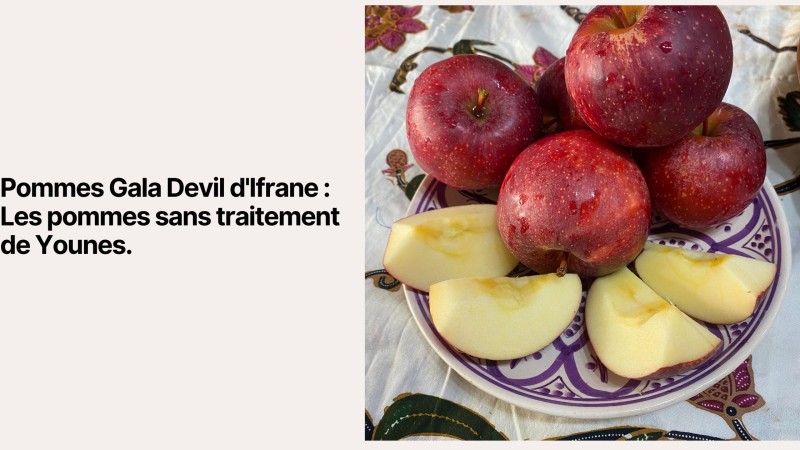
Gala Devil Apples from Ifrane: Younes's Untreated Apples
In the orchards of the Ifrane region, in the heart of Morocco's Middle Atlas, one apple variety stands out for its deep red skin and sweet flavour. Gala Devil, grown without chemical treatment by Younes, a young committed producer, embodies an alternative to a Moroccan apple industry largely dependent on synthetic inputs. While most orchards are heavily treated and imported apples spend months in cold storage, there are producers who make a different choice. At The Green Souk, we have chosen to work with them. A crunchy, juicy, and naturally flavourful fruit that carries within it all the authenticity of Moroccan terroir.
The Hidden Side of Moroccan Apple Orchards
Apple trees occupy a major place in Moroccan arboriculture, with nearly 44,000 hectaresdedicated to this crop, representing around 20% of the country's orchards. The Fès-Meknès region dominates national production, with 354,268 tonnes per year across 15,700 hectares.
But behind these figures lies a concerning reality. In conventional orchards, chemical control is used massively. According to INRA research, there are around 25 chemical interventions per season (insecticides, fungicides, acaricides), of which 12 to 15 treatments are carried out exclusively against the codling moth of apples and pears. This intensity is explained by pest pressure — codling moth, scab, powdery mildew, mites, fire blight — and by market demands that reject any blemished fruit.
Yet this strategy shows its limits. INRA researchers observe a massive influx of codling moth despite an inevitably intense control programme, and some orchards receive up to 15 treatments per season without managing to overcome the populations. Repeated insecticide use has led to the development of resistance, making treatments increasingly ineffective and pushing towards even more frequent interventions — a vicious circle.
Why Are These Treatments Harmful to the Environment?
Excessive pesticide use in apple orchards has direct consequences for ecosystems.
Soil and water contamination. Active substances applied in excess accumulate in soils and migrate into surface and groundwater. In irrigated perimeters, intensive pesticide use disrupts soil microbial communities, which are essential for fertility and crop health.
Effects on biodiversity. Studies conducted on bioindicators show harmful effects on their growth, reproduction, and fertility, with increased mortality. Natural auxiliaries — pollinating insects, pest predators — are the first victims of this chemical pressure, which further destabilises orchards.
A cycle of dependency. As pests develop resistance, farmers increase doses and multiply treatments. This spiral has a considerable environmental and economic cost, without guaranteeing lasting crop protection.
What Risks for Consumers' and Residents' Health?
The consequences do not stop at ecosystems. A major scientific study conducted in the Fès-Meknès region and published in 2026 analysed 31 apple samples taken from local markets and orchards. The results are concerning.
22 pesticide residues detected in 83% of samples, including seven banned compounds. The most frequently found residues are carbendazim (81% of samples) and indoxacarb (68%). Dimethoa
Carbendazim is associated with endocrine disruption, germ cell death, and mutagenic effects. Dimethoate and methomyl are also among the compounds exceeding regulatory limits. The study highlights that 43.6% of surveyed consumers eat apples unpeeled, increasing their dietary exposure.
Agricultural workers and orchard residents are on the front line. Reported symptoms include reduced visual acuity (46%), dizziness (44.3%), headaches (39.4%), and respiratory problems. A urinary biomonitoring study revealed detectable pesticide levels not only in farmers but also in indirectly exposed individuals in the Fès-Meknès region.
Imported Apples: Months in Cold Storage Before Reaching Your Plate
Outside the harvest season, which runs from summer to autumn, a large proportion of apples sold in Morocco comes from cold-stored stocks or imports. Morocco imported 9,300 tonnes of applesin the first ten months of 2024, a record since 2011.
These apples can be stored for up to 10 months in controlled atmosphere. In Moroccan cold storage facilities, apples are stored from mid-September to be sold until July of the following year. To withstand these storage durations, industrial and imported fruits often receive post-harvest treatments — fungicides, waxes — intended to prevent rot and preserve commercial appearance.
These practices are not without consequence for consumers seeking a fresh fruit. An apple that has spent ten months in cold storage, treated after harvest, has neither the texture, nor the flavour, nor the nutritional quality of an apple harvested at maturity and delivered quickly.
Ifrane: A Contrasted Reality
The province of Ifrane is a major player in Moroccan apple growing. It accounts for 45% of regional apple production, followed by Sefrou (28%). Orchards occupy a central place in the local agricultural economy, and the region is often presented as the heart of national production.
But it would be wrong to present it as a preserved territory. As elsewhere in Morocco, the majority of Ifrane's orchards are conventional. Pest pressure — scab, powdery mildew, codling moth — and market demands make the dependence on chemical treatments difficult to break. Producers who choose to do without them are in the minority.
Amid this conventional majority, a handful of producers cultivate without synthetic chemical inputs. Some are elders who perpetuate traditional methods, often out of loyalty to inherited know-how. Others are young people who commit to a more structured approach.
Younes: A Young Producer Committed to Certification
Younes is a young producer from Ifrane who has chosen to cultivate without synthetic chemical inputs. He is committed to certification.
This choice means giving up pesticides, herbicides, and synthetic fungicides, and accepting sometimes lower yields. It is a long-term commitment, driven by the conviction that another kind of agriculture is possible.
Younes will deliver other varieties to us in the coming months. We will follow this collaboration and share the milestones with our community.
Gala Devil: An Apple That Needs No Treatments
Gala Devil is a Gala mutant of Italian origin, developed specifically for southern European regions where apple colouring is difficult to achieve. It stands out for its very intense red colour, superior to that of Galaval, making it one of the most coloured Gala varieties.
Its flesh is sweet, juicy, and crunchy. Its fruits, of medium size (65-80 mm), are remarkably uniform. Its precocity is remarkable: it ripens around one month before Golden Delicious. Its sugar content is high, giving it an intensely sweet flavour.
This precocity allows it to be harvested before peak heat and pest pressure, which facilitates cultivation without chemical inputs.
The Health Benefits of Apples
The apple is one of the most recommended fruits in a balanced diet. Its nutritional richness and low calorie density make it a valuable ally.
Rich in fibre. The apple is an excellent source of pectin, a soluble fibre that regulates intestinal transit, reduces cholesterol by capturing fats in the digestive tract, and promotes satiety.
A source of antioxidants. Apples contain polyphenols and flavon
Vitamins and minerals. Apples provide vitamins C and E, as well as B vitamins. They also contain potassium, which helps regulate blood pressure, and magnesium, involved in many metabolic reactions.
Low calorie density. With around 52 kcal per 100 grams and a water content of about 85%, the apple is a hydrating fruit, ideal for hot days.
How to Enjoy Gala Devil?
Gala Devil, with its firm flesh and sweet taste, lends itself to multiple uses.
-
Fresh, eaten as is: the simplest way to enjoy its crunchy, juicy flesh.
-
In fruit salads: diced with oranges, kiwis, or pomegranates, it adds crunch and a sweet note.
-
In compotes and fresh juices: its sweet flesh requires little or no added sugar.
-
In baking: its firm flesh withstands cooking well in tarts, cakes, or crumbles.
The Green Souk: Certified Producers or Those Whose Commitment We Know
At The Green Souk, our commitment is to offer you fruits that taste good, grown with respect for the land and those who work it.
We work with producers who are certified or whose commitment and seriousness we know well. We know how they work, what their practices are, and we can vouch for them. Our apples come from family orchards where no pesticides, herbicides, or synthetic fungicides are used. Each apple is hand-picked and delivered quickly after harvest, without prolonged storage.
We invite you to discover our Gala Devil apples in our selection of fresh fruits and to follow our news on Instagram, Facebook, and our WhatsApp group so you don't miss any of our arrivals and Younes's progress towards certification.
Conclusion
An apple is not just a fruit: it is a choice. Faced with a Moroccan apple industry largely dependent on chemical treatments, and with imported apples that spend months in cold storage, alternatives exist — carried by traditional producers and by a new committed generation.
By choosing Gala Devil apples from Ifrane, you are supporting healthy, traceable, and respectful agriculture. You are choosing authentic taste and quality, while helping to preserve know-how and terroir.
Discover our Gala Devil apples in our selection of fresh fruits. Follow the arrival of Younes's new varieties on our social media.