
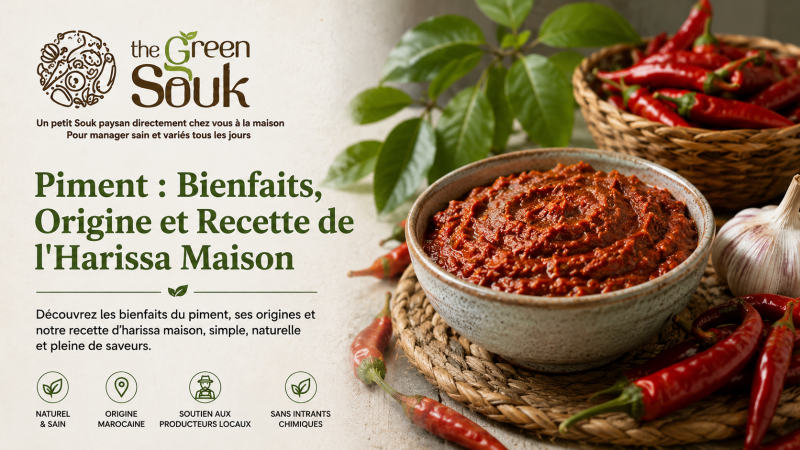
Chili peppers are often reduced to their role as a simple condiment—the one that awakens the palate and adds character to dishes. Yet this fruit, grown in the plains and valleys of Morocco, deserves closer attention. While recently preparing our harissa, we were reminded of the complexity of its flavor and its nutritional contributions. The chili pepper, in its many varieties, is a sensitive indicator of soil quality and farming practices. At The Green Souk, we source them directly from producers who respect the rhythms of the land, without chemical inputs or forced harvests.
The Nutritional Benefits of Chili Peppers: Beyond the Heat
Few foods have suffered from such a reductive reputation as the chili pepper. It is often associated solely with the sensation of oral heat, when in fact it is a concentrate of bioactive compounds beneficial to a balanced diet.
Capsaicin: A Metabolic Ally
The molecule responsible for the heat, capsaicin, is the subject of ongoing nutritional research. Without indulging in miracle promises, several epidemiological studies suggest that it contributes to a slight increase in energy expenditure and better appetite regulation. It works by stimulating certain thermal receptors, triggering a metabolic response comparable to mild exertion. This effect, while well-documented, remains moderate and must be part of an overall balanced diet.
Remarkable Vitamin C and A Content
Contrary to popular belief, fresh chili peppers are among the vegetables richest in vitamin C, ahead of oranges and lemons. A 100-gram portion covers a large part of the daily requirement, provided it is eaten raw or very lightly cooked, as prolonged heat degrades this water-soluble vitamin. They also provide a significant intake of provitamin A (beta-carotene), essential for eye and skin health.
Varied Antioxidants Depending on Color
From green to red to yellow, each variety of chili pepper has a specific antioxidant profile. The pigments responsible for these colors are flavonoids and carotenoids that help neutralize free radicals. Consuming chili peppers of different colors means diversifying your polyphenol sources without resorting to dietary supplements.
Chili Peppers in Moroccan Agriculture: A Crop of Terroir
In Morocco, chili cultivation is not a standardized production line. It is rooted in farming know-how that favors local varieties adapted to arid and semi-arid climates. These varieties, often smaller and fleshier than their industrial counterparts, are the result of peasant selection passed down over several generations.
A Crop Demanding in Water and Care
The chili plant is fragile: it fears both excess moisture and prolonged drought. The producers we work with practice controlled irrigation, often drip irrigation, to avoid waste and limit fungal diseases. This vigilance mechanically reduces the use of fungicides, unlike intensive farming where overhead watering encourages the spread of fungi.
Respect for Seasonality
At The Green Souk, we do not offer chili peppers all year round. The main season runs from late spring to early autumn, with variations depending on the region (Gharb, Tadla, Souss). Accepting this seasonality means rejecting the artifice of heated greenhouses and preservation treatments. It also guarantees a fruit that has ripened slowly, and is therefore richer in natural sugars and aromatic compounds.
Lacto-Fermented Harissa: A Preparation Reduced to the Essentials
Our harissa does not follow traditional recipes that include garlic, cumin, or oil. It relies on a deliberately pared-down protocol, requiring neither sophisticated equipment nor superfluous ingredients. The choice of lacto-fermentation, combined with a minimal composition—crushed chili peppers and unrefined natural salt—actually imposes a greater requirement: nothing masks any potential defects in the fruit or standardizes its flavor. The quality of the final product therefore depends entirely on the quality of the harvest.
Unrefined natural salt, as extracted and simply crushed, is not a seasoning. Incorporated into the chili paste, it creates an environment favorable to the lactic acid bacteria naturally present on the fruit's cuticle, while limiting the development of undesirable microorganisms. These bacteria convert the chili's sugars into lactic acid, which lowers the pH and ensures spontaneous preservation, without heat sterilization or chemical additives. This process preserves some of the fragile vitamins that heat would destroy.
Why exclude garlic, cumin, and oil? This choice is not an impoverishment, but a refocusing on the chili itself.
-
Garlic and spices, in a fermenting medium, can introduce wild yeasts or competing bacteria that disrupt the lactic balance.
-
Oil, for its part, forms a physical barrier that limits the exchanges necessary for homogeneous fermentation, and can become rancid upon prolonged contact with the moisture of the crushed fruit.
We therefore make a bet on this naked simplicity: the aromas must come exclusively from the chili peppers and their fermentative metabolism, so that the consumer can judge the quality of the raw material on its own merits.
Our Production Protocol: Washing, Grinding, Salting
The production of our harissa is summed up in three operations, with no cooking or pre-cooking:
-
Washing: The chili peppers are carefully rinsed with clean water to remove any soil residues and harvest dust.
-
Grinding: They are then reduced to a homogeneous paste, without adding water, in order to preserve the full organoleptic qualities of the fruit.
-
Addition of unrefined natural salt: This salt is incorporated directly into the paste. It initiates and regulates the lacto-fermentation, which gradually transforms the crushed mixture into a stable and flavorful preparation.
Beyond these steps, time and resting conditions do the rest, without us ever adding water, spices, oil, or preservatives. Once fermentation has begun, it is monitored regularly, but its conduct does not follow a fixed recipe: it adapts to the harvest, the variety, and the season. Each batch is therefore slightly different—which we consider not a flaw, but the signature of a living product.
Using Chili Peppers Daily Without Excess
One of the pitfalls of chili peppers is the urge to constantly increase the heat. Fortunately, Moroccan culinary culture distinguishes between the use of mild chili (for color and smoothness) and hot chili (for character). In a tagine, chili blends into the sauce; in a salad, it is grilled and peeled; in powdered form, it is added at the end of cooking to preserve its volatile aromas.
Integrating chili into one's diet is not about seeking gustatory performance, but rather learning to dose it and listen to one's body's reactions. Morocco's high temperatures make it a natural ally for perspiration, helping to regulate internal temperature—an adaptive function well known to residents of hot regions.
Why Choose Chili Peppers from The Green Souk?
Rather than lengthy speeches, here are three concrete reasons, validated by our sourcing charter:
-
Clear traceability: Each batch of chili peppers is linked to an identified producer, with their plot and farming practices.
-
No post-harvest treatments: Unlike imports, our chili peppers undergo no waxing, fungicide treatment, or irradiation.
-
Short supply chain delivery: Reducing intermediaries allows for harvesting at optimal ripeness, rather than early picking to meet long-distance transport needs.
We invite you to browse our selection of fresh vegetables to discover the current arrivals. Chili peppers are a priority there, accompanied by other nightshades (tomatoes, eggplants, bell peppers) that make up the Moroccan summer.
Simple Recipe: Homemade Harissa in Five Steps
For those who wish to replicate our experience, here is a minimal step-by-step guide, requiring no specialized equipment (a mortar or food processor is sufficient).
-
Step 1: Gather 500 g of fresh red chili peppers, 100 g of dried chili peppers (rehydrated for 15 minutes in warm water), 6 garlic cloves, 2 teaspoons of cumin, 1 teaspoon of salt, 10 cl of olive oil.
-
Step 2: Lightly grill the fresh chili peppers on a pan or griddle, without fat, until the skin blisters. Partially peel them (some traces of skin can be left for flavor).
-
Step 3: Blend the garlic, cumin, and salt into a paste. Add the peeled fresh chili peppers and the drained rehydrated chili peppers. Blend gradually.
-
Step 4: Incorporate the olive oil in a stream while blending, until a thick but homogeneous paste is obtained.
-
Step 5: Transfer to a clean jar, cover with a thin layer of oil, and let rest for 24 hours in a cool place before the first tasting.
Note: The heat of the harissa varies depending on the chili peppers used. We recommend tasting the paste before adding salt to adjust the proportion of hot chili peppers.
Conclusion
The chili pepper is neither a medicine nor a challenge. It is a demanding fruit vegetable, telling a story of climate, labor, and agricultural choices. At The Green Souk, we believe that defending it means first defending the conditions of its cultivation: living soils, reasonable water inputs, manual harvesting. The harissa we have prepared is merely an illustration of this value chain. Each bite reminds us that authenticity is not sold—it is cultivated.
If you wish to extend this discovery, we invite you to explore our range of natural spices or to consult our article on summer vegetable preservation methods.